Sixteen short answers.
The questions the village asks us most often, with short and (we hope) plain-English answers. If your question is not here, please write to [email protected] and we will reply within seven working days.
How do I apply for a grant?
Write us a letter — half a page is plenty — or email [email protected]. Tell us who you are, what you would like help with, and the rough amount. We reply within seven working days and decide at the next quarterly board meeting (January, May or July).
Who can apply?
Anyone living in Deiniolen, or a child of the village, or a Deiniolen community organisation. We will also consider applications from immediately adjacent hamlets (Clwt-y-bont, Dinorwig, Penisarwaun, Brynrefail) where the applicant is part of village life.
Do you have an online application form?
No, deliberately. A letter — by post or by email — is a small but real piece of trust between you and the four of us. It also keeps our administrative costs at zero.
How long does a decision take?
Routine applications are decided at the January or July board meeting; we will tell you in our acknowledgement which meeting yours will be considered at. A reserve meeting takes place in May for any urgent items. Galar a Gwellhad decisions can be taken between meetings, by phone.
What is the largest grant you give?
In normal years, about £450. The largest single grant in the trust’s history was £600 (Memorial Hall re-slating, 1989). We do not fund anything above £500 without the unanimous agreement of all four trustees.
Can you support a major capital project?
No. The trust’s total annual income is approximately £3,000. We will sometimes make a small contribution toward a larger appeal organised by another body, but we cannot lead or substantially fund a building project.
Will my application be kept confidential?
Yes. Application letters and decisions are held in a buff folder at 9 Deiniol Road, accessible only to the four trustees, for seven years (the period required for Gift Aid records). They are not shared with any third party except where the law requires (e.g. safeguarding). See our privacy policy.
Can I apply in Welsh?
Yes — Welsh is our preferred working language, and most of our correspondence with the village is in Cymraeg. English is available; please tell us which you would prefer.
Do I need to be a UK taxpayer to donate?
No, but if you are, Gift Aid lets us claim an extra 25p of every £1 you donate at no cost to you. There is a tick-box on the donate page.
How do you use my personal data?
We use it to send the grant cheque, to claim Gift Aid (if applicable), and to send our quarterly dispatch if you ask for it. Full detail is in our privacy policy.
Are the trustees paid?
No. None of the four trustees are paid; none receive expenses; all four are volunteers in the strictest sense. The trust has no employees.
Is the trust regulated?
Yes — by the Charity Commission for England and Wales. We are charity number 219993, governed by a Scheme of 22 May 1980. Our public record is at the Commission’s register.
How do I become a trustee?
The Scheme allows for between four and eight trustees. New trustees are appointed by the Charity Commission on the recommendation of the existing trustees, taking into account suggestions from the village. If you would like to be considered, write to the trustees by post or email.
Where is the registered office?
9 Deiniol Road, Deiniolen, Caernarfon, LL55 3LL. That is Marina’s house; she has agreed to take the post for the year. The trust does not have an office in the sense of a separate building.
Can I visit?
Yes — please write or phone first. Our open day, Diwrnod y Cyhoedd, is the first Saturday in June each year at the Memorial Hall; you are very welcome without an appointment that day.
How can I help if I am not in the village?
Three things. You can donate a small sum that we will add to our 2026 grant pot. You can subscribe to our quarterly dispatch. And, if your Welsh is fluent, you can volunteer as a translator; the work is light and can be done by post.
In pictures, the most common scenarios.
Three small images that cover, between them, about ninety per cent of the questions in the post.
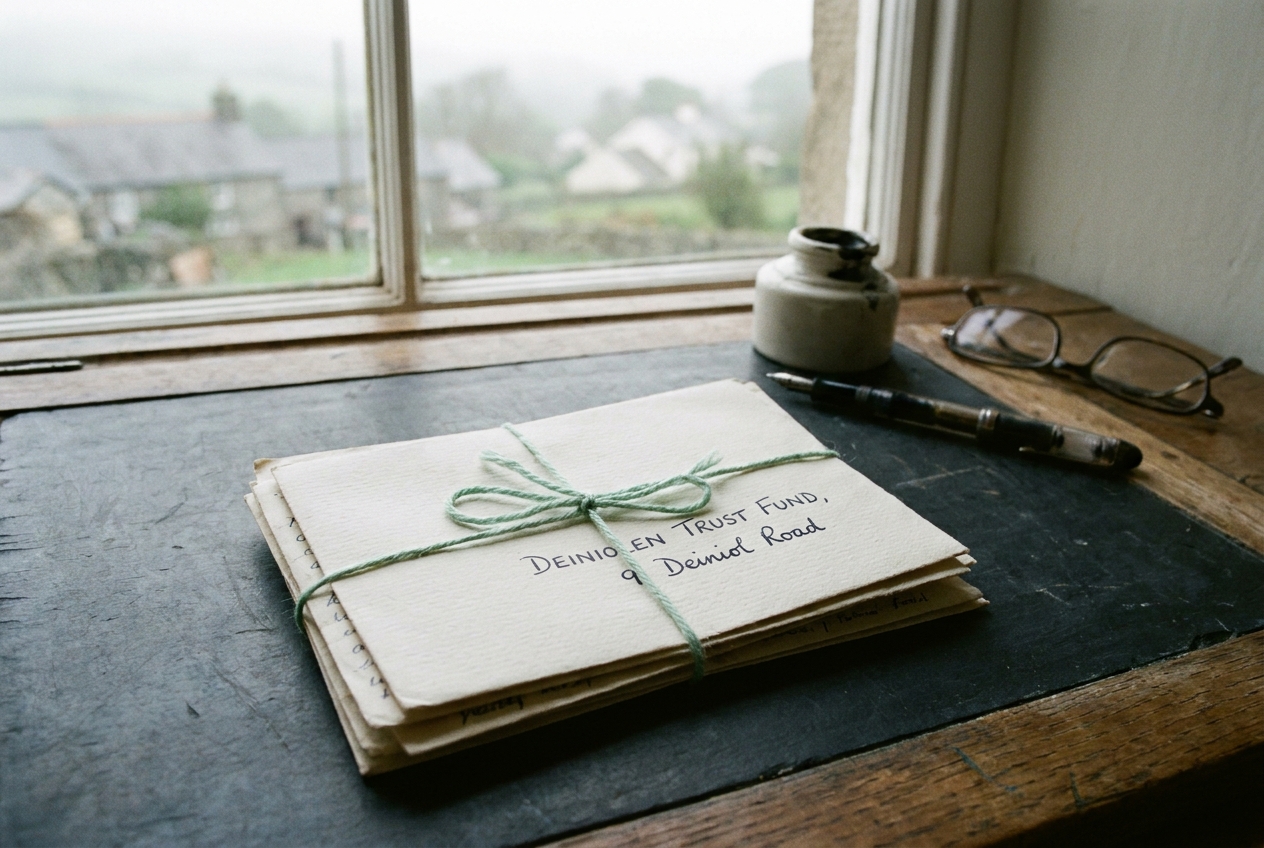
The post bag, mid-week.
Six to ten letters in a typical week. Most are about Llaw i’r Aelwyd; a handful about Lle i Ddysgu.

A villager’s list of questions.
Most letters open with two or three of the questions on this list. We answer them in the order they are asked.

The reply.
Most replies are a single side of A4, handwritten in fountain-pen ink. We type only when the request requires a longer reply.
A few more questions.
Do you ever publish names of grant recipients?
Only with permission, and not for hardship grants under Llaw i’r Aelwyd. Organisations we have helped (the football club, the history society, the school) are happy to be named; individuals we help under hardship are never named.
Do you take Gift Aid on cash donations?
Yes, where the donor has signed a declaration. We claim Gift Aid in two batches a year, in April and October, on every eligible donation received in the previous six months. The arithmetic adds, in a normal year, roughly £400 to our income.
Do you have a safeguarding policy?
Yes, refreshed in May 2025 and reviewed at the July board meeting. A PDF is on the resources page. All four trustees have a DBS basic check and re-check every three years.
Can a group from outside Deiniolen apply for a grant on behalf of a Deiniolen resident?
Yes. A school in Bangor, for example, may apply on behalf of a Deiniolen child enrolled there. The beneficiary must be a Deiniolen resident; the applying organisation can be anywhere.
What is the average grant size?
£344.89 in 2025 (nine grants summing to £3,104). The median, which is more representative of a typical grant, was £80.
How many trustees were there in 1980?
Four. The Scheme allows for between four and eight; the trust has, in practice, run as a four-trustee board for most of its life. There were briefly five (1989–1991) and six (2003–2008); both phases ended without controversy when trustees stood down at the end of their terms.
Do you ever say no to a donor?
Rarely, but yes. We have declined donations from organisations whose work is incompatible with the trust’s objects, and from individuals whose giving conditions would compromise our independence. We do not publish the details; we always reply by post.
Still stuck?